
When it comes to property management, successful outdoor pole light troubleshooting is the difference between an inviting, secure commercial facility and a parking lot that looks like the set of a late-night horror movie. Most business owners in South Florida don’t give their exterior illumination a second thought until a fixture goes completely dark or a pole starts leaning at a highly suspect angle.
However, ignoring the early warning signs of electrical failure doesn’t just hurt your curb appeal—it actively invites massive liabilities, increased crime, and hefty replacement bills. If you’ve arrived at the point where you’re desperately searching for solutions while staring at a flickering high-pressure sodium bulb, don’t panic. You’ve officially entered the exciting world of commercial electrical maintenance, which is exactly as thrilling as it sounds.
💡 Critical Takeaway: The 2026 Liability Reality
The most crucial note for any facility manager is this: well-lit properties experience up to a 40% reduction in nighttime vandalism and slip-and-fall claims. A proactive approach to lighting maintenance isn’t just an operational expense; it is a fundamental shield against premises liability lawsuits in 2026.
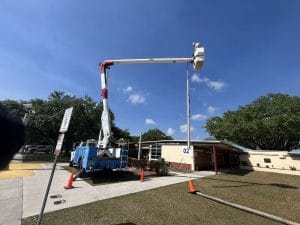
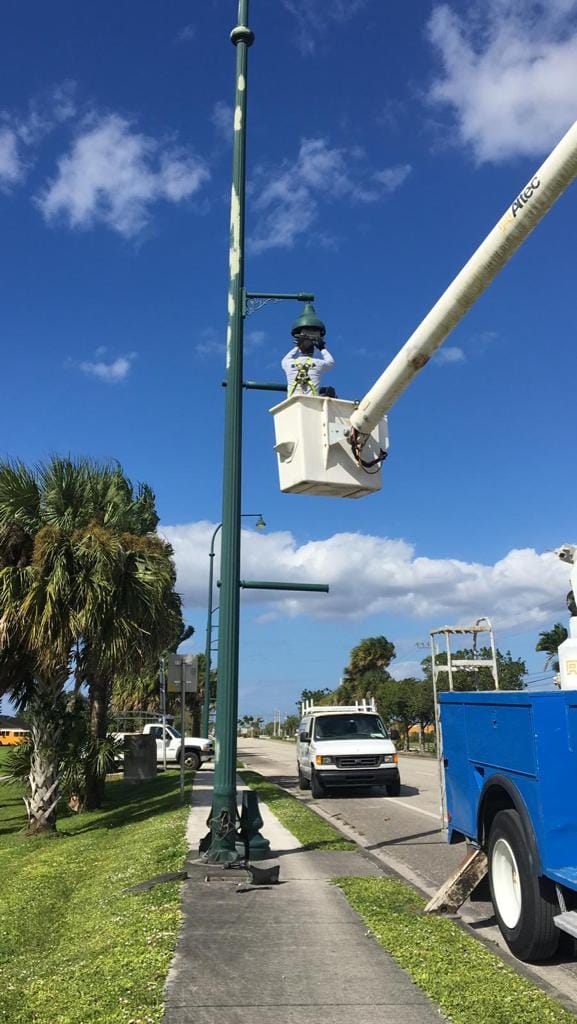
To directly answer your core search intent regarding outdoor pole light troubleshooting, the process requires a systemic, top-to-bottom diagnostic approach. You must first verify that the main breaker panel and lighting contactors are supplying correct voltage, then ensure the photocells and timer mechanisms are functioning appropriately for the time of day. If the controls are fine, the physical structure of the base, the underground wiring conduits, and the components inside the luminaire head (like ballasts, LED drivers, or capacitors) must be inspected for degradation, rust, or short circuits. If the problem resides high in the air, a professional electrical contractor with an aerial bucket truck is absolutely mandatory.
Quick Reference: The 7 Commercial Lighting Culprits (Summary)
- 1. Anchor Bolt Mismatches: The engineering headache of fitting new poles on old concrete foundations.
- 2. Physical Base Damage: Structural deterioration caused by careless delivery trucks and landscaping equipment.
- 3. Severe Base Rust: The inevitable result of South Florida’s coastal humidity eating untreated metal.
- 4. Inadequate Illumination: Failing fixtures that create dangerous shadows and dark zones.
- 5. The Strobe Effect: Flickering components that signal imminent ballast or LED driver failure.
- 6. Control Malfunctions: Faulty photocells keeping lights on at noon and off at midnight.
- 7. Underground Faults: Compromised conduits causing frustrating, repetitive main breaker trips.
Table of Contents
- 1. Mismatched Bolt Patterns or Wrong Base Plate
- 2. Worn Down Light Pole Base & Physical Damage
- 3. Rusted Light Pole Base (The Florida Special)
- 4. Low Light & Inadequate Illumination
- 5. The Dreaded Flickering Commercial Pole Lights
- 6. Photocell and Timer Malfunctions
- 7. Underground Wiring & Breaker Issues
- Preventative Maintenance & Pro Upgrades
- Why American Lighting & Electrical Services?
1. Mismatched Bolt Patterns or Wrong Base Plate
If you have decided that it is time to upgrade your aging commercial lighting system, you might logically assume that a new pole of the same height will easily slip onto the old concrete base. Unfortunately, this assumption will introduce you to a world of frustration during your outdoor pole light troubleshooting journey. Older commercial light poles generally feature significantly larger, wider bolt circle measurements compared to the sleeker, modernized poles manufactured in 2026. The geometry simply doesn’t align.
Even if you try to be clever and purchase replacement poles from the exact same manufacturer that produced your original equipment, you will often find infuriating quarter-inch discrepancies in the base plate drillings. Over the decades, manufacturing standards shift, engineering tolerances tighten, and wind load rating requirements evolve. Trying to force a new, highly-engineered base plate onto an archaic anchor bolt layout is like trying to fit a square peg into a round hole using nothing but sheer willpower and colorful vocabulary.
How do professional electricians resolve this without completely jackhammering the entire concrete footing? Proper outdoor pole light troubleshooting for foundation issues involves meticulous pre-planning. If you are pouring new concrete, using the manufacturer’s exact anchor bolt template is non-negotiable. If you are retrofitting, you can deploy a customized light pole adapter plate. This thick steel bridge safely marries the old foundation’s anchor layout to the new pole’s base plate, ensuring structural integrity isn’t compromised. Just remember, cutting or torching the new base plate to “make it fit” is a surefire way to void your warranty and invite a catastrophic failure during the next high wind event.
2. Worn Down Light Pole Base & Physical Damage
Parking lots are essentially demolition derbies where the drivers are distracted by their phones, their coffee, or their screaming children. Because of this harsh reality, the bases of commercial lighting poles take an absolute beating. A critical phase of outdoor pole light troubleshooting is conducting a visual physical inspection of the pole’s lower five feet. You will likely find a museum of dents, deep scratches, missing paint, and severe discoloration from years of vehicular impact and landscaping equipment abuse.
While a few scratches might seem purely cosmetic, they act as an open door for moisture. Furthermore, when your customers navigate your facility, they aren’t looking at the pristine LED fixture thirty feet in the sky; their eye level is right at the battered, bruised base. A heavily damaged pole base subtly communicates to visitors that property maintenance is neglected. But beyond aesthetics, a deep structural dent from a heavy delivery truck can fundamentally compromise the pole’s engineered wind-load rating.
For minor aesthetic blemishes discovered during outdoor pole light troubleshooting, the simplest fix is to install high-impact decorative light pole base covers or rugged powder-coated aluminum skirts. These clamshell designs seamlessly snap around the base, hiding the ugly truth while adding a layer of impact resistance against future bumper taps. However, if the pole is leaning or visibly buckled, cosmetic covers are useless. In these severe cases, you require a full structural replacement, which requires heavily specialized bucket truck electrical services to safely dismantle the damaged hazard.
🔍 Structural Note: When a Dent Becomes a Danger
Not all damage is cosmetic. If a vehicle strike has indented the pole’s circumference by more than 10%, the structural integrity is severely compromised. During high wind events, this weak point becomes the exact spot where the pole will fold. Always prioritize a full structural assessment during routine inspections over simply covering up the problem.
3. Rusted Light Pole Base (The Florida Special)
If there is one thing South Florida weather excels at, it is quietly and relentlessly destroying unprotected metal. Over the years, the protective powder coat finish on a standard steel lighting pole begins to weather and degrade. The moment that barrier fails, the coastal salt air, heavy rains, and intense humidity trigger the unstoppable process of galvanic corrosion. Effective outdoor pole light troubleshooting in this region means actively hunting for rust before it compromises the core structure.
Rust isn’t just an eyesore; it is a ticking time bomb. The most vulnerable area is directly at ground level, precisely where water pools and landscaping sprinklers constantly saturate the metal. If left unchecked, ground-level rust will completely eat through the steel wall thickness. A corroded pole that snaps at the base can crush vehicles, destroy property, and result in catastrophic personal injury. It is a massive liability that no property manager can afford to ignore.
If you catch it early during your routine outdoor pole light troubleshooting, surface-level rust can sometimes be aggressively wire-brushed, chemically neutralized, and sealed with an industrial zinc-rich coating. However, if you can poke a screwdriver through the rusted metal, it is game over. To combat the harsh Florida climate permanently, many facility managers are upgrading to fiberglass or marine-grade aluminum light poles. These materials physically cannot rust, offering decades of structural peace of mind.
To ensure your commercial lighting assets remain compliant with rigorous safety and performance guidelines, it is highly recommended to reference the best practices published by the National Electrical Contractors Association (NECA). Their standardized installation and maintenance protocols are the gold standard for avoiding weather-related structural failures.
4. Low Light & Inadequate Illumination
There is nothing more unsettling than walking to a parked car across a lot that feels like a shadowy labyrinth. When your lighting fixtures fail to provide adequate illumination across your entire property, you create distinct dark zones. These poorly lit areas are prime real estate for vandalism, theft, and security breaches. Effective outdoor pole light troubleshooting isn’t merely ensuring a light turns on; it is ensuring the light reaches the ground where it is actually needed.
Evaluating your commercial property means considering both the quantity of the fixtures and the quality of their photometric distribution. If you have older metal halide or high-pressure sodium lights, you’ve likely noticed severe lumen depreciation. This means the bulbs are still drawing full electricity and burning brightly at the source, but they are producing a fraction of the actual light output they did five years ago. This gradual dimming creeps up on facility managers, slowly plunging the property into darkness.
To properly execute outdoor pole light troubleshooting for low light issues, you must map the dark spots. Are the fixtures blocked by overgrown oak trees? Have the optical lenses yellowed and clouded over from UV exposure? The ultimate fix is usually modernizing the system. High-quality commercial LED fixtures use advanced, precision-engineered optics that push light exactly where it belongs, virtually eliminating dark corners and drastically improving the clarity of security camera footage. Upgrading your exterior illumination footprint is one of the most impactful outdoor lighting investments a business can make.
💰 Budget Strategy: The Cost of Lingering Issues
Ignoring flickering or dim lights doesn’t save money. Old, failing HID systems will continually attempt to restrike, drawing massive amounts of startup current and inflating your utility bill. Transitioning to LED technology during major repairs provides a massive energy reduction that often covers the replacement cost within a few years.
5. The Dreaded Flickering Commercial Pole Lights
Your parking lot is supposed to be a safe, welcoming environment, not a chaotic underground rave. When customers are greeted by aggressively flickering commercial pole lights, it instantly degrades their perception of your business. Flickering is universally recognized as a sign of electrical distress, and it can actively trigger headaches and eye strain for both your employees and your patrons.
When you begin outdoor pole light troubleshooting for a strobe-light effect, the underlying cause largely depends on the generation of technology installed on the pole. If you are operating legacy high-intensity discharge (HID) lamps, the culprit is almost always a dying magnetic ballast struggling to regulate the massive voltage required to arc the gas inside the bulb. Alternatively, the bulb itself might have reached the end of its lifespan, entering a frustrating “cycling” phase where it warms up, shuts down, and tries again indefinitely.
If your property has already been upgraded to LED fixtures and you are still experiencing rapid flickering, the diagnostic process shifts. In LEDs, flickering usually points to a failing electronic driver. The driver acts as the brain of the fixture, converting high-voltage AC power into the steady, low-voltage DC power the diodes require. When drivers overheat or suffer from voltage spikes, they lose their ability to provide smooth power. Because replacing these internal components requires working with live voltage thirty feet in the air, this is absolutely a scenario that demands professional outdoor light pole repair solutions. Don’t grab an extension ladder and hope for the best.
6. Photocell and Timer Malfunctions
Have you ever driven past a massive commercial plaza at high noon on a blazing summer day and noticed every single parking lot light is shining brightly? It makes you wonder if the property manager simply enjoys giving their money directly to the utility company. This incredibly common, wasteful scenario is the direct result of a control system failure, usually pointing straight to a malfunctioning photocell.
A photocell is a small, relatively inexpensive light-sensitive sensor. It acts as the eyes of your lighting system, telling the contactors to turn the power on at dusk and off at dawn. As a crucial step in outdoor pole light troubleshooting, checking the photocell should be one of your first actions. When photocells fail, engineers have smartly designed them to fail in the “ON” position. This ensures your parking lot doesn’t go completely dark and create a massive security risk, but it does mean your lights will burn 24/7 until the sensor is replaced.
Sometimes, complex outdoor pole light troubleshooting yields embarrassingly simple solutions. Before you call an electrician, look up at the photocell. Is it covered in dirt? Did a bird decide the sensor was the perfect place to leave a deposit? If the sensor’s eye is physically blocked, it will think it is constantly nighttime. If cleaning the eye doesn’t work, or if your property relies on a digital astronomical time clock that has lost its programming due to a power surge, you will need a professional to recalibrate the control panel and replace the faulty relays.
⚠️ Safety Alert: Respect the Voltage
Commercial outdoor lighting is not wired like the lamps in your living room. These systems operate on highly lethal 277-volt or 480-volt commercial circuits. An accidental shock at these voltage levels is often fatal. Never attempt to bypass a lighting contactor or splice wires without commercial electrical licensing and proper personal protective equipment.
7. Underground Wiring & Breaker Issues
There are times when the pole itself is in pristine condition. The fixture is brand new, the LED driver is healthy, the photocell is squeaky clean, and yet, an entire row of lights refuses to illuminate. When multiple poles go dark simultaneously, your outdoor pole light troubleshooting focus must shift from the fixtures in the sky down to the dirt beneath your feet.
Commercial lighting systems are wired via underground PVC conduits, daisy-chaining the electrical feed from one pole base to the next. These underground runs face a brutal environment. Ground shifting, heavy seasonal flooding, tree root intrusion, and overzealous landscaping crews driving stakes into the ground can easily crack or sever these protective conduits. Once the physical barrier is broken, groundwater seeps in, making contact with the exposed copper wiring.
This water intrusion causes an immediate, massive short to ground, which violently trips the main breaker back at the electrical room. If a breaker refuses to reset, do not force it. Forcing a breaker closed against a dead short is a fantastic way to start an electrical fire or blow up the panel. Professional outdoor pole light troubleshooting for underground faults requires specialized gear. Electricians use advanced ground fault locators and megohmmeters to send signals down the wire, pinpointing the exact location of the break beneath the asphalt without needing to blindly trench the entire parking lot. If your system keeps tripping, you need to bring in experts equipped for heavy-duty pole lighting troubleshooting.

Preventative Maintenance: Stop Problems Before They Start
The smartest and most cost-effective strategy for dealing with outdoor pole light troubleshooting is preventing the failures from occurring in the first place. Reactive maintenance—the practice of simply waiting until half your parking lot is pitch black before scrambling to hire a contractor—guarantees maximum stress and premium emergency service fees.
Establishing a proactive, scheduled preventative maintenance routine changes the game. Property managers should mandate monthly nighttime drive-throughs to identify and log every flickering bulb, burned-out head, and dark zone. Furthermore, scheduling an annual professional inspection is critical. A licensed technician can verify the torque on anchor bolts, inspect the waterproof seals on luminaire housings, clean optical lenses, and ensure that the grounding wires are perfectly intact.
If you find that your aging infrastructure requires constant, expensive patching, it is likely time to perform a full system audit. Stop throwing good money after bad. By evaluating current industry standards, you can easily calculate the massive long-term energy and maintenance savings associated with a full system upgrade. For an accurate look at modern upgrade economics, review comprehensive data on parking lot light replacement cost specific to the South Florida market.
Why Choose American Lighting & Electrical Services?
Beyond the primary issues detailed in this guide, commercial lighting systems harbor countless other complex nuances. From localized voltage drops to catastrophic lightning strike damage, these electrical networks require deep technical expertise. Proper outdoor pole light troubleshooting is not a guessing game—it is an exact science that demands specialized tools, dedicated bucket trucks, and a profound respect for commercial voltage.
When you find yourself out of your depth, it is time to call in the heavy hitters. If you need reliable, expert parking lot light pole repair in West Palm Beach or anywhere across South Florida, American Lighting & Electrical Services is your definitive partner. Operating under State License EC1304819, we bring over 40 years of combined, battle-tested experience to every single job site.
We have spent decades mastering the electrical, lighting, and sign industry. This deep well of experience means we can execute flawless outdoor pole light troubleshooting on any system, regardless of the manufacturer, the pole height, or the complexity of the internal wiring. Your employees and customers deserve a brilliantly lit, secure environment, and you deserve a maintenance partner that prioritizes your peace of mind.
We are actively looking forward to helping you resolve your lighting headaches! Don’t let a dark parking lot damage your reputation or invite unnecessary liability. Take full advantage of our professional fleet and highly trained technicians to secure your commercial property today. Put an end to the flickering, the dark zones, and the electrical stress—give us a call directly at 561-689-4854, and let’s get those lights blazing beautifully once again.