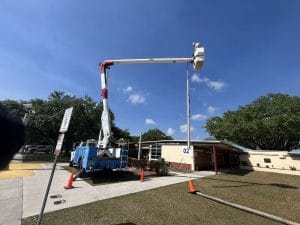
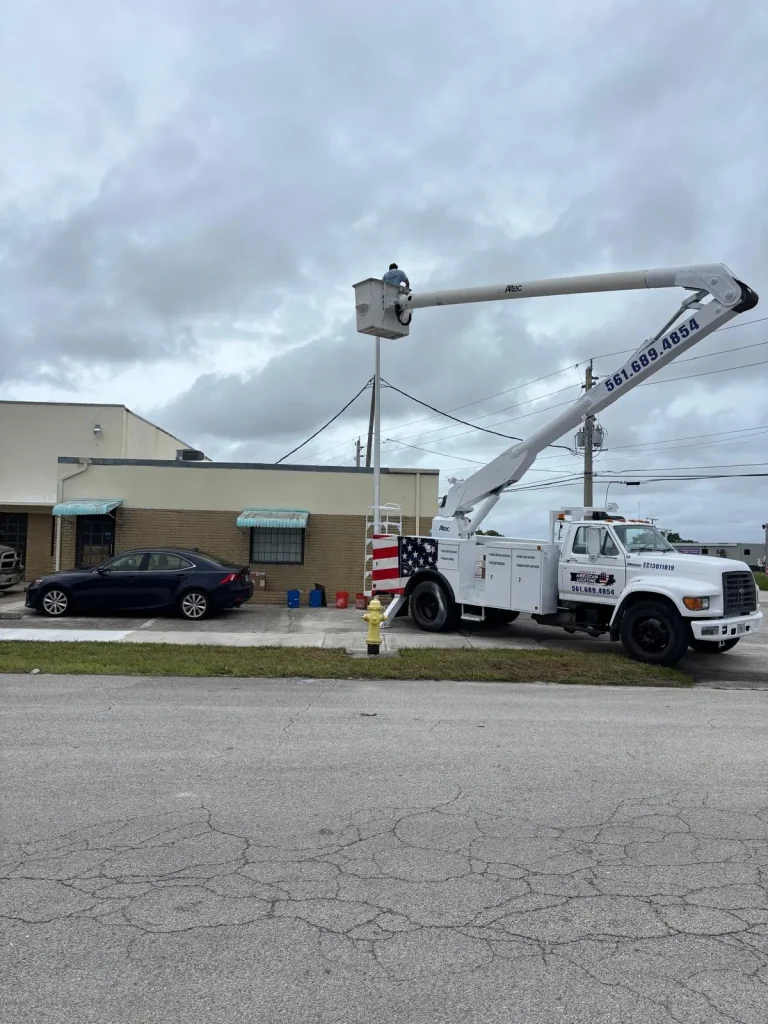
Let’s have a serious, yet slightly elevated chat about bucket truck electrical safety. If you have ever stared up at a flickering 40-foot parking lot light and thought, “I could probably just stack three extension ladders, balance them on the back of my cousin’s pickup, and tape them together,” congratulations—you have successfully identified what not to do. Working at height is no joke, and unless you possess the proportional speed, strength, and web-shooting abilities of a certain radioactive spider, gravity is simply not your friend. The reality is that modern commercial and municipal lighting projects demand professional access equipment to mitigate catastrophic risks, which is why bucket truck electrical safety is the undisputed champion of the modern job site.
At its core, proper bucket truck electrical safety is the systematic approach to using insulated, mechanized aerial platforms to safely perform high-reach electrical maintenance, installations, and repairs. This ensures workers remain protected from fall hazards, electrical shocks, and unstable environmental conditions while delivering precise, code-compliant lighting solutions.
At a Glance: The Pillars of Aerial Safety (Featured Summary)
| Safety Feature | Primary Benefit |
|---|---|
| Fall Prevention | Enclosed buckets with harness anchors eliminate ladder-sway risks. |
| Dielectric Protection | Insulated booms protect against accidental high-voltage arcs. |
| Precision Positioning | Controlled hydraulics mean no awkward reaching or straining. |
| Tool Management | Secure bins prevent dropped tools from becoming projectiles. |
| Public Protection | Consolidates the work zone, keeping pedestrians clear of hazards. |
1. The Evolution of Aerial Safety in 2026
We have come a long way from the days of hoping the wind doesn’t blow too hard while someone clings to a precarious aluminum ladder. Today, bucket truck electrical safety represents a sophisticated blend of hydraulic engineering, ergonomic design, and rigorous operator training. It is the gold standard for any commercial or municipal lighting project in South Florida, ensuring that the technicians fixing your lights actually make it home for dinner. The evolution of this machinery is nothing short of a technological marvel.
Ladders are perfectly fine if you are cleaning your gutters or trying to retrieve a stuck frisbee from a low-hanging branch. But they belong nowhere near a 277-volt commercial lighting array. As we navigate the complex landscape of modern infrastructure, ensuring the structural integrity of your access equipment is step one. Ignoring bucket truck electrical safety in favor of cheaper alternatives is like bringing a spoon to a sword fight—it’s ineffective and inherently dangerous.
When you hire a professional crew, you aren’t just paying for the bulb replacement or the ballast swap. You are investing in a heavily engineered piece of mobile safety equipment. Proper bucket truck electrical safety protocols dictate that these vehicles undergo daily hydraulic inspections, boom structural tests, and dielectric testing. Finding out your boom’s fiberglass insulation has a hairline crack while you are 35 feet in the air staring at a live transformer is, frankly, suboptimal timing. We prefer our surprises in the form of unexpected birthday cake, not unexpected electrocution.
Furthermore, the year 2026 brings new automated stabilizing technologies to these trucks. Outriggers now feature smart-leveling sensors that assess the ground’s density. If the ground is too soft, uneven, or prone to shifting, the truck simply refuses to elevate. It’s like having a highly cautious, robotic safety inspector riding shotgun with your crew at all times. This automation is a cornerstone of modern bucket truck electrical safety, removing the element of human error from the stabilization process.
2. Comprehensive High Reach Electrical Safety Standards
If you love reading through hundreds of pages of federal regulations, you are in luck. If you prefer to have a social life, let us summarize it for you. Navigating high reach electrical safety standards requires a deep understanding of complex guidelines. It is a dense web of rules designed by incredibly smart (and probably very cautious) people to keep everyone alive and well on the job site.
One of the most critical aspects of these standards is weather protocol. We all know the weather can change from “pleasant afternoon” to “apocalyptic thunderstorm” in roughly twelve minutes, especially in South Florida. High-wind protocols are a massive part of bucket truck electrical safety. When wind speeds exceed the manufacturer’s safety threshold—usually around 28 to 30 mph—the boom comes down. No exceptions. We don’t care if the mayor is waiting for the lights to turn on; you cannot fight aerodynamics.
The Rigorous Dielectric Testing Mandate
The boom of an aerial lift is your literal lifeline, acting as a non-conductive barrier. However, daily wear, grease, and micro-fissures can turn a safe fiberglass arm into a conductive hazard. Modern standards mandate comprehensive dielectric testing. This ensures that the insulation properties of the truck remain uncompromised, proving that proactive maintenance is the beating heart of safety.
Another major factor is the environmental hazard assessment. Before a boom even leaves its cradle, a competent operator must evaluate the site. Are there unmarked overhead lines? Is the asphalt compromised? Are there hidden sinkholes near the parking lot drain? The implementation of bucket truck electrical safety starts long before the technician goes airborne. It starts with looking at the ground and looking up at the sky.
3. The Mandatory Pre-Trip Inspection
You wouldn’t jump out of an airplane without checking your parachute, and you shouldn’t go up in a bucket without inspecting the truck. The pre-trip inspection is a non-negotiable ritual. It is the bedrock of bucket truck electrical safety, designed to catch mechanical failures before they become mid-air emergencies. A proper inspection takes time, and patience is a virtue we highly encourage when gravity is involved.
First, technicians check all hydraulic hoses for leaks, bulges, or abrasions. High-pressure hydraulic fluid is what keeps the boom in the air. A sudden loss of pressure can cause a rapid, uncontrolled descent—a fancy term for falling very fast. Maintaining these systems is how we enforce bucket truck electrical safety on every single job. Next, the outriggers are tested for smooth deployment. If they grind or hesitate, the truck goes to the mechanic, not the job site.
Inside the bucket, the control panel must be tested. Every toggle, joystick, and emergency stop button must function flawlessly. There are also lower controls on the truck chassis, which act as a manual override. If the technician in the bucket is incapacitated (perhaps stung by a surprisingly aggressive bee), the ground crew must be able to lower them safely. This dual-control redundancy is a massive part of bucket truck electrical safety, proving that backup plans are always necessary.
4. 5 Benefits of Professional Aerial Equipment
Let’s get into the meat and potatoes of why this equipment is so vital. Using the right tool for the job isn’t just about showing off your fancy trucks; it is about efficiency, liability reduction, and keeping everyone’s limbs fully attached. Let’s explore how robust bucket truck electrical safety measures actively improve the outcome of your commercial lighting projects.
Benefit 1: Stable and Controlled Access at Height
As mentioned earlier, ladders rely entirely on balance, flat ground, and the user’s core strength. Bucket trucks are designed to provide a secure, locked-in platform for electricians working at elevation. Controlled movement via hydraulic joysticks allows for pinpoint positioning, meaning you get exactly where you need to be without stretching like a yoga instructor. This stability is the core of bucket truck electrical safety.
This stability allows technicians to maintain a proper, ergonomic working posture. They can use both hands safely during complex wiring repairs instead of using one hand to hold on for dear life. When you aren’t worried about falling, you can actually focus on the complicated wiring schematic in front of you. For elevated lighting systems, this stable access is the foundational element of bucket truck electrical safety.
Benefit 2: Reduced Risk of Falls and Injuries
Gravity has an undefeated record; it is batting a thousand. Falls are consistently a leading cause of injury in construction and electrical work. Bucket trucks significantly reduce this risk by incorporating passive safety features like tall, heavy-duty guardrails and active features like engineered harness anchor points. Proper bucket truck electrical safety means understanding that the bucket isn’t a suggestion—it’s a fortress.
When you combine these built-in safeguards with highly trained operators, you create a controlled micro-environment. This minimizes fall-related incidents, which is a massive advantage for complex lighting projects in busy commercial spaces. If you need this level of security and professionalism for your business operations, exploring comprehensive commercial electrical services is your absolute best first step.
Benefit 3: Improved Safety Around Live Components
Lighting repairs rarely happen in a perfectly de-energized, sterile environment. They often involve troubleshooting live circuits, failing ballasts, faulty LED drivers, and modern smart-control systems. Trucks specifically designed for this work include insulated booms that drastically reduce the risk of accidental phase-to-ground contact. This insulation is a lifesaver and a pillar of bucket truck electrical safety.
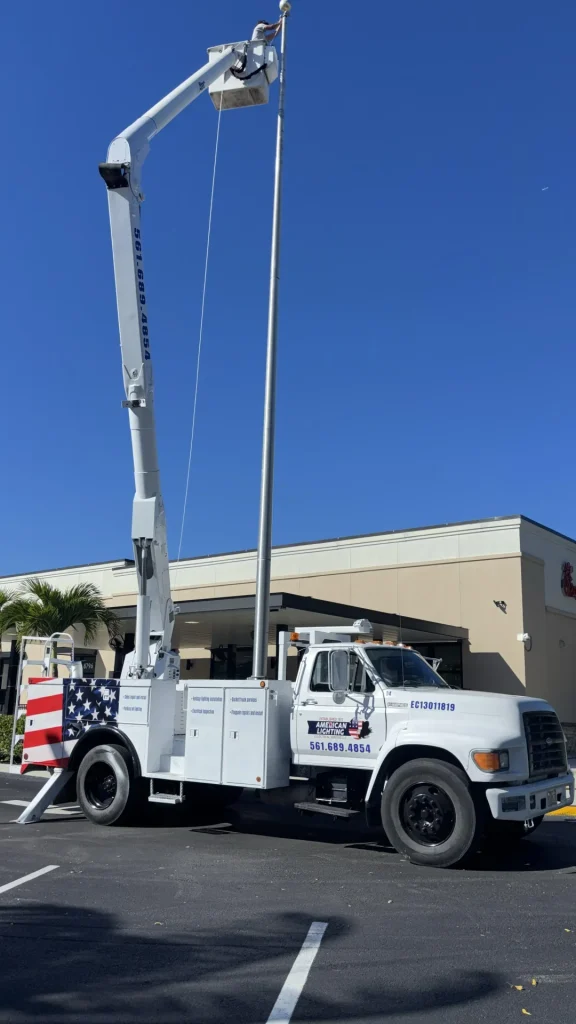
This insulation adds a massive layer of protection, particularly in humid or coastal environments where moisture in the air increases electrical conductivity. This dielectric barrier is a primary reason why strict bucket truck electrical safety is championed by industry leaders. You cannot put a price tag on a technician’s life, but you can certainly put an insulated boom between them and the danger.
Highlight: The Unseen Dangers of Urban Environments
Working in South Florida means dealing with highly congested airspaces. From low-hanging telecom cables to intertwined tree branches hiding primary power lines, the urban canopy is a minefield. Specialized bucket trucks allow operators to meticulously navigate these tight spaces, preventing snagged lines and ensuring the surrounding infrastructure remains completely intact.
Benefit 4: Better Positioning Means Higher-Quality Work
Poor positioning leads to awkward angles, dropped screws, and rushed, sloppy repairs. Have you ever tried to thread a tiny needle while doing a plank exercise? That’s exactly what repairing a commercial ballast from an extension ladder feels like. Bucket trucks allow technicians to glide effortlessly to the exact optimal viewing angle, which is a massive win for bucket truck electrical safety and work quality.
There is a direct correlation between operator comfort and work quality. When a technician is not fatigued from balancing, they can ensure accurate fixture alignment, secure weather-tight wiring connections, and proper seating of delicate LED components. Good safety protocols literally pay for themselves through longer-lasting repairs. Adhering to bucket truck electrical safety means doing the job right the very first time.
Benefit 5: Safer Worksites for the Public and Property
Most commercial lighting projects take place in parking lots, roadways, or retail spaces that cannot fully shut down their operations. You constantly have pedestrians texting while walking, and cars navigating tight spaces as if they are in a Formula 1 race. Bucket trucks help establish a highly visible, controlled safety perimeter. This perimeter management is essential for bucket truck electrical safety.
By minimizing the chaotic footprint of scattered ladders, tools, and extension cords, and utilizing the truck’s flashing beacons and cones, you create a safer zone. Comprehensive bucket truck electrical safety protects not just the elevated worker in the air, but the distracted shopper on the ground who is entirely unaware of the heavy maintenance happening right above their head.
5. Personal Protective Equipment (PPE) Requirements
You can have the most advanced, laser-guided, 2026-model aerial lift in the world, but if the operator is wearing flip-flops and a tank top, you have failed miserably at safety. Personal Protective Equipment (PPE) is the last line of defense in the layered strategy of bucket truck electrical safety. It is what saves you when all the mechanical and environmental controls fail.
Electrician aerial lift safety dictates the mandatory use of arc-rated clothing. Arc flashes are terrifying explosions of electrical energy that can cause severe burns in a fraction of a second. Arc-rated shirts and pants do not easily ignite and will self-extinguish, protecting the wearer. This specialized clothing is an absolute non-negotiable component of bucket truck electrical safety protocols.
Then we have the hands and eyes. Operators must wear voltage-rated rubber gloves, which are rigorously tested and dated, worn underneath leather protectors to prevent punctures. For the face, an arc-rated face shield attached to a hard hat is required to protect against sparks, debris, and UV radiation. Yes, wearing all this gear in the blazing summer sun is roughly as comfortable as sitting in a sauna while wearing a snowsuit. However, true bucket truck electrical safety requires a little sweat to prevent a lot of tragedy.
6. Risk Reduction and Legal Compliance
Let’s talk about liability, which is a word that makes property managers, facility directors, and business owners wake up in a cold sweat at 3 AM. High-reach safety isn’t just about having good vibes on the job site; it is a strict compliance requirement. Federal and state regulations actively mandate the use of proper access equipment for specific elevated tasks. Ignoring bucket truck electrical safety is essentially writing a blank check to your lawyers.
To fully understand the heavy legal weight of these regulations, you can review the authoritative guidelines provided by the Occupational Safety and Health Administration (OSHA) regarding aerial lifts. Following these stringent, government-mandated guidelines is not optional if you want to avoid staggering financial fines, operational shutdowns, and massive legal exposure.
Highlight: The True Cost of Negligence
Attempting to bypass professional equipment rentals to save a few hundred dollars usually results in a financial disaster. Property damage from falling fixtures, damaged landscaping from heavy untrained machinery, or—worst of all—worker injury will eclipse the cost of professional services exponentially. Safety is an investment, while negligence is an unpayable debt.
By strictly mandating bucket truck electrical safety on your commercial properties, you ensure all operations align with the latest OSHA standards. This alignment drastically reduces your liability exposure. It ensures proper daily documentation, vehicle inspection logs, and verifies that the contractors you hire are maintaining their own insurance compliance, protecting your bottom line.
It’s important to note that this level of compliance and care applies to high-end residential scenarios as well, particularly for large estates, private tennis courts, or HOAs with towering streetlights. Using proper equipment is just as vital for residential electrical repairs as it is for massive industrial shopping malls. Gravity doesn’t care if it’s a house or a warehouse.
7. When to Call the Professionals
Knowing when to step back, put away your tool belt, and call the cavalry is a vital management skill. Not all lighting jobs are created equal. While changing a standard bulb on a residential porch light is a quick DIY weekend task, diagnosing an intermittent short circuit in a 30-foot parking lot pole is a strictly professional endeavor. Embracing bucket truck electrical safety means acknowledging the limits of improvised solutions.
Projects involving tall concrete poles, massive stadium fixtures, overhead line repair safety, or generally hard-to-access locations require highly specialized machinery. Professional teams arrive with the heavy truck, the specialized training, and the bucket truck electrical safety protocols already deeply integrated into their daily workflow. You are hiring their equipment, but more importantly, you are hiring their cultivated expertise.
If you are managing commercial parking lots, sports facilities, expansive industrial exteriors, or warehouse perimeters, please don’t leave it to chance. You can dive deeper into the logistics of how this specialized service works by checking out our dedicated service page outlining our bucket truck electrical services. We have the fleet ready to roll.
The difference between a frantic, dangerous repair and a smooth, professional installation comes down to one thing: preparation. For a more detailed breakdown of project timing, specific scopes of work, and what to expect when the fleet arrives, read our comprehensive guide on exactly when to hire a bucket truck for electrical projects.
8. Frequently Asked Questions
Are bucket trucks really safer than ladders for lighting work?
Yes, by a massive and undeniable margin. Bucket trucks provide a heavy, stable platform, built-in fall protection harness anchors, and smooth, controlled positioning that ladders simply cannot offer. Ladders are prone to kicking out, slipping, or being blown over by a stiff breeze. Strict bucket truck electrical safety eliminates these common variables.
How do aerial lifts reduce electrocution hazards?
Proper bucket truck electrical safety relies heavily on the truck’s physical design. The boom section is typically constructed from heavy-duty, electrically insulated fiberglass. This prevents the vehicle from creating a grounded circuit if the technician accidentally contacts a live high-voltage wire, saving their life in the process.

Is using aerial equipment legally required for commercial lighting repairs?
In many specific scenarios, yes. OSHA safety standards, local municipal codes, and property insurance policies frequently dictate that specific heights and tasks require mechanical aerial lifts. Failing to adhere to bucket truck electrical safety regulations can result in severe fines, project shutdowns, and voided insurance coverage.
What kind of training is required to operate this machinery?
It’s not like renting a moving van for the weekend. Operators must undergo specific, documented training that covers hydraulic controls, emergency descent procedures, weight load limits, dielectric testing awareness, and advanced bucket truck electrical safety site hazard assessments. It is a highly specialized skill set.
Can weather affect aerial lift operations?
Absolutely. High winds, lightning, and heavy rain are immediate stop-work conditions. Professional operators carry anemometers (wind speed gauges) and strictly adhere to the manufacturer’s maximum wind rating to prevent the truck from tipping over. Weather awareness is a huge part of bucket truck electrical safety.
Conclusion: Elevating Your Standards
When it comes to maintaining your property’s electrical infrastructure, the equipment you choose dictates the final outcome. We’ve established that proper bucket truck electrical safety isn’t just an industry buzzword used in meetings; it is a comprehensive, life-saving system of machinery, training, and strict procedural discipline. It is the dividing line that separates the reliable professionals from the dangerous, liability-inducing amateurs.
For commercial, municipal, and large residential properties, investing in the right team with the right access equipment is the ultimate peace of mind. It ensures that your lighting stays bright, your liability stays low, and the professionals working on your property make it home safely for dinner. It is a win for the property, a win for the public, and a win for the technician in the air.
Don’t let your next major lighting project turn into a high-wire circus act. Rely on tested, inspected, and professionally operated aerial equipment. Because when you prioritize top-tier bucket truck electrical safety, everyone wins—except gravity. Gravity can just sit this one out.