
When it comes to flagpole repair Florida property managers and homeowners face a unique set of challenges that simply do not exist in other parts of the country. Between the relentless barrage of UV radiation baking the synthetic fibers of your halyards, the corrosive coastal salt air eating away at metal truck assemblies, and the annual threat of hurricane-force winds attempting to relocate your commercial display to the next county, maintaining a flagpole here is practically an extreme sport.
A beautiful, towering flag is a symbol of pride, freedom, and institutional permanence, but when the pole is leaning like a tired tourist at a theme park, or the rope is violently snapping against the metal shaft at 2 AM, it quickly becomes a liability. After over four decades of hands-on experience in the electrical, lighting, and sign industry across South Florida, we have seen every conceivable way a flagpole can fail, bend, break, or seize up under the punishing tropical climate.
2026 Critical Safety Highlight
According to the latest 2026 structural engineering reports from the American Society of Civil Engineers (ASCE), coastal micro-corrosion in base brackets and internal winch failure account for over 73% of unexpected commercial flagpole collapses during tropical storm events. Routine professional inspections can identify these microscopic stress fractures long before they become a dangerous, multi-thousand-dollar property insurance claim.
If you are frantically searching for a way to fix a jammed halyard, straighten a leaning base, or repair a broken finial, the answer is to hire a specialized, localized flagpole installation and repair team equipped with bucket trucks to safely diagnose and resolve the issue. By relying on licensed professionals, you ensure that your flagpole is restored to peak structural integrity, compliant with 2026 Florida building codes, and ready to safely fly your colors through the next storm season.
At a Glance: Professional Flagpole Repair Florida Essentials
- Core Services: Base foundation realignment, truck (pulley) replacement, internal/external halyard stringing, and finial ornament restoration.
- Florida Lifespans: Commercial-grade aluminum poles can last 30+ years, but exposed ropes, cables, and mechanical parts require replacement every 2 to 4 years due to extreme weather.
- Equipment Required: For poles exceeding 20 feet, commercial bucket trucks and OSHA-certified safety harnesses are mandatory; ladders are highly dangerous and often ineffective.
- Compliance: All South Florida installations and significant repairs must adhere to updated 2026 high-velocity hurricane zone (HVHZ) wind-load requirements.
Table of Contents
- 1. Why Is My Flagpole Leaning? Understanding Foundation Shifts and Repairs
- 2. Common Flagpole Repair Problems: Understanding What Can Go Wrong
- 3. Flagpole Rope and Halyard Replacement: When and How to Replace Them
- 4. Professional Flagpole Repair Florida Light Installation Standards
- 5. The Necessity of Bucket Truck Electrical Services
- 6. What Goes Into a Commercial Flagpole Installation in Florida?
- 7. Flagpole Wind Damage: Florida Storms, Wind Loads, and Structural Safety
- 8. How to Repair a Flagpole: What You Can Check and When to Call a Professional
- 9. Material Science: Aluminum, Fiberglass, and Steel
- 10. Flagpole Maintenance: How to Prevent Repairs Before They Start
- 11. Flagpole Repair Guide: Diagnose Common Problems Before Calling for Service
- 12. Frequently Asked Questions (FAQs)
1. Why Is My Flagpole Leaning? Understanding Foundation Shifts and Repairs
Do you notice the flagpole has fallen out of alignment? Do you need to straighten your flagpole? It’s unfortunate, but in Florida, it can happen more often than you might think. Our state is basically a giant sandbar sitting on top of porous limestone, which means ground shifting is a way of life.
When you combine our naturally unstable soil with the torrential downpours of the summer wet season, the earth around the concrete foundation of a flagpole can easily erode, soften, or shift. Once the ground gives way even a fraction of an inch, the sheer weight of a 40-foot aluminum pole, combined with the leverage created by a flag catching the wind, will cause the entire structure to lean.
Flagpoles fall out of alignment constantly, but it is not a situation you should ignore. A leaning pole is not merely a cosmetic issue that makes your commercial property look a bit sloppy; it is a structural hazard. When a pole is no longer perfectly plumb, the stress of the wind is no longer distributed evenly down the shaft into the foundation. Instead, it creates localized stress points at the base sleeve. Over time, this uneven tension can cause the metal to fatigue and the concrete footing to crack. If left unaddressed, the pole could snap or completely uproot during a severe weather event.
Fortunately, we have the tools, experience, and skill to fix it easily. Specialized flagpole installation and repair in West Palm Beach can help, whether it is a large commercial flagpole gracing a corporate headquarters or a standard residential flagpole in a gated community.
If you need flagpole realignment, give a call to the expert flagpole installation and repair team, and they will help you get your flagpole standing straight again. The process usually involves excavating around the existing foundation, utilizing heavy-duty hydraulic jacks and rigging to perfectly level the pole, and pouring specialized, rapid-curing structural epoxy grout to permanently secure the new alignment. We ensure the flash collar is re-seated properly, hiding the dirty work and leaving you with a pristine, perfectly vertical display.
2. Common Flagpole Repair Problems: Understanding What Can Go Wrong
To truly understand how to fix a flagpole, or even just how to describe the problem to a dispatcher on the phone, you need to understand the anatomy of the beast. A flagpole is much more than a metal stick protruding from the lawn; it is a carefully engineered system of moving parts designed to withstand immense environmental pressure. At the absolute pinnacle of the pole sits the finial or ornament—typically a gold anodized ball or an eagle. While mostly decorative, the finial also prevents water from pouring directly down the open top of the pole.
Directly beneath the ornament is the most critical mechanical component: the truck assembly. The truck houses the pulley (or sheaves) over which the rope travels. Trucks can be stationary (fixing the flag in one direction) or revolving (allowing the flag to spin around the pole with the wind, preventing the flag from wrapping around the shaft). In Florida’s salt air, revolving trucks frequently seize up if not regularly lubricated. When the bearings rust and lock into place, the truck stops spinning, the flag wraps tightly around the pole in the next breeze, and your display is ruined until a repair crew arrives.
Component Spotlight: Internal vs. External Systems
By 2026, the industry has heavily shifted toward internal halyard systems for commercial properties. Unlike traditional poles where the rope is tied to an outside cleat, internal systems conceal a wire cable inside the hollow pole, operated by a secure, key-locked winch mechanism near the base. This completely eliminates the infuriating “clanking” sound of ropes hitting metal in the wind, and practically eradicates the risk of flag theft and vandalism.
Moving down the pole, you have the halyard itself, which is the rope or cable used to hoist the flag. Attached to the halyard are the snap hooks, usually made of brass or stainless steel, which physically clip into the flag’s grommets. Over time, these metal clips can wear incredibly thin due to the constant friction of the wind tossing the flag. Finally, at ground level, you have the cleat (for external systems) or the winch access door (for internal systems), the ground sleeve (the tube set into the concrete), and the flash collar (the decorative metal skirt that covers the ugly concrete foundation).
Understanding these components makes diagnosing common flagpole repair problems much easier. A flag that will not raise, a rope that keeps slipping, a seized truck assembly, or a pole that has started leaning may look like completely different problems, but each usually points back to a specific mechanical or structural component. A professional inspection works from the finial all the way down to the foundation, identifying the actual point of failure before a minor problem develops into a much larger repair.
3. Flagpole Rope and Halyard Replacement: When and How to Replace Them
The halyard is the circulatory system of your flagpole. Without a functioning rope, your flag is grounded, and your pole is just a very tall, very expensive yard ornament. You should check the rope each time you raise and lower your flag. You are looking for the early warning signs of degradation: pilling fibers, thinning sections, stiffness caused by salt crystallization, and obvious fraying. In the harsh Florida sun, ultraviolet rays aggressively break down standard synthetic ropes. Even high-grade polyester ropes will eventually succumb to UV rot and the constant friction against the truck’s pulley.
It will be a significantly more accessible and cheaper fix if you replace the rope at the very first signs of fraying. Why? Because if the rope is still intact, a professional flagpole rope replacement service can perform the repair from the ground. We simply take the new halyard, tape it securely end-to-end with the old halyard, and pull the old rope down, which automatically threads the new rope up and over the pulley at the top of the pole. It takes minutes and costs a fraction of a high-altitude rescue.
However, if you wait until the rope actually snaps, the broken ends will fall to the ground. Suddenly, there is absolutely no way to thread a new rope without physically sending a human being 40, 50, or 60 feet into the air to manually feed the new rope through the truck assembly.
Do you have any trouble related to broken halyards, snaps, ropes, cables, winches, or lighting in your flagpole? Specialized flagpole installation and repair provide a wide range of services, flagpole parts, and accessories to fix the job in no time. We stock premium, multi-braid solid core polyester ropes with woven wire centers designed specifically to resist the shearing force of high winds, ensuring your next halyard lasts significantly longer than the last.

4. Professional Flagpole Repair Florida and Flagpole Light Installation Standards
According to the United States Flag Code, it is the universal custom to display the flag only from sunrise to sunset on buildings and on stationary flagstaffs in the open. However, when a patriotic effect is desired, the flag may be displayed 24 hours a day if properly illuminated during the hours of darkness. Leaving a flag flying in the pitch black is not just a breach of etiquette; it defeats the entire purpose of having the display in the first place.
Proper flagpole light installation is a highly technical endeavor that requires balancing aesthetic appeal with strict electrical safety codes. You cannot simply point a cheap hardware store spotlight at the sky and hope for the best. To properly illuminate a flag at 40 feet, you need lighting fixtures with specifically calculated optics. A narrow spot beam (usually 15 to 20 degrees) is required to push the light all the way to the top of the pole without spilling excess light pollution into the surrounding neighborhood or blinding drivers on nearby roadways.
Furthermore, because these lighting systems are exposed to Florida’s heavy rains, sprinkler systems, and occasional flooding, the electrical work must be flawless. Subterranean wiring must be housed in waterproof PVC conduit, and all above-ground fixtures must carry a high Ingress Protection (IP) rating, typically IP65 or higher. This level of technical electrical integration is why property managers rely on specialized commercial electrical experts. We can install sophisticated LED systems that turn on automatically via photocell sensors, adjust color temperatures to make the red, white, and blue vividly pop against the night sky, and wire everything back to your main breaker panel with absolute safety and code compliance.
Lighting Efficiency Insight
Upgrading your old metal halide or halogen flagpole lights to 2026-standard high-output LEDs not only provides a cleaner, brighter light, but it can reduce the energy consumption of your outdoor display by up to 80%. When scaled across a large commercial property, this upgrade often pays for itself in energy savings within the first 18 months of operation.
5. The Necessity of Bucket Truck Electrical Services
Let’s paint a picture that is all too common in property management: Your flagpole is 50 feet tall. The halyard just snapped in a sudden afternoon thunderstorm, and the flag is currently wadded up in a wet, tangled mess at the very top of the pole. The maintenance guy suggests taping three extension ladders together and “giving it a shot.” This is the exact moment you need to intervene and prevent an absolute tragedy. Flagpoles are entirely freestanding, smooth, and taper as they get higher. They offer zero support for a ladder. Leaning a heavy ladder against a tall, thin aluminum tube is an exercise in terrifying physics that usually ends with a trip to the emergency room.
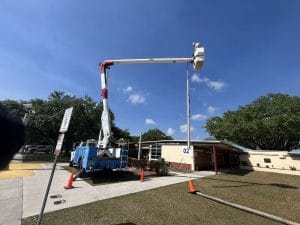
They have state-of-the-art equipment that can lift them to reach 30- 100 ft flag poles easily. To safely repair anything above 20 feet, a bucket truck is non-negotiable. An aerial lift allows our trained technicians to rise smoothly alongside the pole without touching or leaning on it. Once positioned comfortably above the finial, the technician has both hands free to safely inspect the truck assembly, drill out seized screws, lubricate bearings, and re-thread cables without fighting gravity or risking their life.
Operating bucket trucks requires rigorous OSHA certification and a deep understanding of fall protection protocols. By utilizing our in-house bucket truck electrical services, we eliminate the need to rent expensive third-party equipment. We bring the heavy machinery directly to your site, secure the perimeter, safely boom up to the absolute peak of your installation, and execute the repair swiftly. We inspect the flagpoles, diagnose the original problem areas, and decide exactly what parts are needed while we are up there, ensuring the job is done right the first time.
6. What Goes Into a Commercial Flagpole Installation in Florida?
When dealing with commercial real estate, municipalities, car dealerships, and large corporate campuses, flagpole installation becomes a completely different project from setting up a small residential pole. We are no longer talking about a 20-foot pole that arrives in a cardboard tube. Commercial flagpoles can reach 60, 80, or even 100 feet, turning what looks like a simple installation into a serious engineering and construction project.
The process begins long before the pole ever arrives on site. The location has to be evaluated for underground utilities, surrounding structures, wind exposure, soil conditions, access requirements, and the size of the foundation needed to support the pole. Taller installations may require engineered concrete footings, ground sleeves, reinforcement, grounding provisions, and equipment capable of safely lifting and positioning the pole.
Material selection matters just as much. Aluminum, fiberglass, steel, and other materials behave differently under wind, moisture, salt exposure, and long-term structural stress. In Florida, those decisions become particularly important because coastal conditions can accelerate corrosion while severe storms place enormous loads on the pole and its foundation.
For property managers planning a new installation, these variables are why commercial flagpoles should be evaluated as engineered site features rather than simple accessories. Our Commercial flagpole installation team in West Palm Beach can evaluate the property, determine the appropriate installation approach, and handle the project from site planning through final installation.

7. Flagpole Wind Damage: Florida Storms, Wind Loads, and Structural Safety
Flagpoles are influenced intensely by changes in weather conditions. In Florida, “weather conditions” is a polite euphemism for “category 4 hurricanes that want to flatten your zip code.” A flagpole is an aerodynamic structure, but when you attach a giant piece of fabric to it, you have effectively created a sail. The amount of force generated by a 12×18-foot flag snapping in 80 MPH winds is staggering. It places immense torque on the base and can literally bend a lower-grade pole at a 45-degree angle.
The fully trained flagpole installation and repair team in West Palm Beach can provide you with a hassle-free solution in such a situation. We provide safe anchoring to ensure that it will hold up against strong winds and other elements. This means ensuring your pole is rated for the correct wind speed. In 2026, the Florida Building Code mandates specific wind load tolerances based on your exact distance from the coastline. A pole installed inland might be rated for 120 MPH, while a pole installed on the coast of Palm Beach might require a 170 MPH rating. We ensure that your pole has the appropriate wall thickness and base diameter to meet these stringent, life-saving legal requirements.
Furthermore, they can install flagpoles on the ground or the side of the top of your building. Roof-mounted and wall-mounted flagpoles require entirely different engineering metrics. We’ve all the brackets and fixings required to safely set up your flagpole, working to all typical angles you desire. Roof mounts must be tied directly into the structural steel or concrete superstructure of the building to prevent tearing the roof apart during a gale. It is high-stakes engineering that requires absolute precision.
Hurricane Prep Tip
Never leave a flag flying during a named tropical storm or hurricane. Not only will the flag be shredded into expensive confetti within hours, but the drag it creates will almost certainly destroy the pole. Bring your flags down, secure the halyards tightly to the pole to prevent them from whipping around and damaging the finish, and double-check the tightness of your flash collar.
8. How to Repair a Flagpole: What You Can Check and When to Call a Professional
The DIY Delusion: Why Heights and Hubris Don’t Mix
In the age of internet tutorials, it is incredibly tempting to watch a five-minute video, grab a toolbox, and attempt to conquer a massive repair project yourself. “How hard can it be to swap a pulley?” you might think. But the reality of commercial flagpole repair is far less forgiving than fixing a leaky sink. The moment you step off the ground, the risk factor multiplies exponentially. Your toilet has been hissing for longer than most celebrity marriages, and you can take your time fixing that. But a 50-foot pole swaying in the wind while you try to balance on a lift is not the place for amateur hour.
Beyond the severe risk of bodily harm, amateur repairs often cause permanent damage to the expensive hardware. Using the wrong thread pitch when replacing a finial will strip the truck assembly. Using mismatched metals—like slapping a cheap steel bolt onto an aluminum pole—will trigger galvanic corrosion, rapidly rusting out the connection and destroying the structural integrity of the pole from the inside out. What started as an attempt to save a few hundred dollars usually results in requiring an entirely new flagpole.
This is why understanding the importance of professional flagpole installation and repair in West Palm Beach is so crucial for property managers. The thoroughly experienced flagpole installation and repair experts possess years of experience supplying hassle-free solutions to your flag and flagpole needs. They provide expert advice, comprehensive reports, and installation plans to clients, making sure that they meet all health and safety regulations that prevail in the area. Let the people with the bucket trucks and the liability insurance take the risks, so you can go stare at a wall for ten minutes—you’ve earned it.
9. Material Science: Aluminum, Fiberglass, and Steel
Not all flagpoles are created equal, and choosing the right material is the foundation of a display that will last for decades. In the Florida market, three primary materials dominate the landscape, each with its own specific strengths and weaknesses.
Aluminum: The undisputed champion of commercial flagpoles. Specifically, 6063-T6 aluminum tubing provides a brilliant combination of high yield strength and lightweight properties. Aluminum naturally forms a microscopic layer of oxide that protects it from deep rust, making it highly resistant to salt air. When treated with an anodized finish (available in clear, bronze, or black), it becomes practically impervious to the elements. The vast majority of our commercial installations utilize spun aluminum.
Fiberglass: Fiberglass flagpoles are an excellent alternative, particularly in coastal areas with extreme salt spray. Because fiberglass is entirely non-metallic, it physically cannot rust or corrode. It is also non-conductive, which provides a slight safety advantage in lightning-prone areas (though all poles should be properly grounded regardless). Fiberglass has a high flex-tolerance, meaning it can bend significantly in high winds and snap back to plumb. However, the gel-coat finish can degrade over time under intense UV light, requiring periodic repainting and refinishing to prevent the fiberglass from “blooming” or shedding fibers.
Steel: While incredibly strong, steel flagpoles are a rarity in modern Florida installations. Even galvanized or thickly painted steel will eventually rust in our humid, salty environment. Steel is incredibly heavy, making installation and maintenance difficult and expensive. Steel is generally reserved only for monumental flagpoles—those reaching heights of 150 feet or more—where the sheer size requires the absolute maximum tensile strength available.
10. Flagpole Maintenance: How to Prevent Repairs Before They Start
The flagpoles must be regularly maintained and kept in safe working order. It is also safe for both the public and employees who walk beneath these towering structures every day. The biggest mistake property owners make is treating their flagpole like a fire hydrant—ignoring it completely until it is desperately needed or spectacularly broken. Preventative maintenance is the key to longevity.
Regular flagpole maintenance prolongs its life and ensures the flag can fly correctly and safely for longer. A beautifully maintained flag with bright lighting and a straight pole will be an ideal option to promote your business’s reputable image. Conversely, a tangled, ripped flag on a leaning, dirty pole signals to customers that management lacks attention to detail.
The work of flagpole installation and repair in West Palm Beach includes flagpole installation, repair, replacement, re-tensioning of guy ropes, and the complete cleaning down and repainting of aged surfaces. Specialized professionals have a range of flagpole installation and repair maintenance packages to choose from. We can also create bespoke maintenance packages that are tailored to your specific requirements. This might include quarterly halyard inspections, bi-annual truck lubrication, annual structural leveling checks, and immediate dispatch services prior to major storm events. By putting your flagpole on a routine maintenance schedule, you shift the cost from an unexpected capital emergency to a predictable operational expense.
11. Flagpole Repair Guide: Diagnose Common Problems Before Calling for Service
Before you call in the cavalry, it is helpful to know exactly what is going wrong. Still reading? Right. You’re the kind of person who likes to know how things work, which is either a virtue or a warning sign, but either way, you’ll know more about flush mechanisms and flag mechanics than 98% of adults, which you can use at dinner parties. Or, more realistically, you cannot. Here is a quick diagnostic checklist for the ambitious property manager:
- Symptom: The flag won’t come down.
Diagnosis: The halyard is likely wedged off the pulley wheel and stuck between the sheave and the truck housing, or the truck bearings have completely rusted and seized. Action: Do not pull harder; you will snap the rope. Call for bucket truck service. - Symptom: The rope is clicking loudly inside the pole.
Diagnosis: For internal halyard systems, the retainer ring or counterweight has detached, causing the wire cable to slap against the inner aluminum walls. Action: The access door needs to be opened, and the weights need to be re-secured or replaced. - Symptom: The pole is vibrating or humming loudly in the wind.
Diagnosis: This is known as harmonic resonance. The wind speed is perfectly matching the natural frequency of the pole. Action: While generally harmless structurally, it can be annoying. We can install harmonic dampeners or alter the flag size to disrupt the resonance. - Symptom: Black streaks are running down the pole.
Diagnosis: The rubber or metal of the revolving truck assembly is degrading, or dirt has accumulated at the top and is washing down in the rain. Action: The pole requires a deep cleaning and the truck needs inspection for degrading seals. - Symptom: The flagpole is starting to lean.
Diagnosis: A leaning pole can indicate foundation movement, soil erosion, a shifting ground sleeve, or structural damage at the base. Even a small change in alignment deserves attention because wind places additional stress on a pole that is no longer perfectly vertical. Action: Check the base for cracked concrete, visible movement, or gaps around the ground sleeve. Significant leaning should be professionally evaluated before the pole is used normally. - Symptom: The halyard is frayed or becoming difficult to raise.
Diagnosis: UV exposure, salt, moisture, and constant friction against the pulley gradually weaken flagpole ropes. A damaged truck assembly can accelerate that wear by forcing the halyard against an uneven or seized pulley. Action: Replace a worn halyard while it is still intact whenever possible. Once it snaps, accessing the top of a tall pole may require an aerial lift or bucket truck. - Symptom: The flagpole moved or bent after a severe storm.
Diagnosis: High winds can place enormous loads on the pole, foundation, truck assembly, and mounting hardware. A pole may appear mostly normal after a storm while still having loosened hardware, foundation movement, or structural damage. Action: Lower the flag if it can be done safely and inspect the pole from the ground. A visibly bent, leaning, cracked, or unstable flagpole should be professionally inspected before returning it to service. - Symptom: The flag will not raise or lower smoothly.
Diagnosis: The problem may be a frayed halyard, seized pulley, damaged truck assembly, tangled internal cable, or worn winch mechanism. Continuing to force the system can turn a relatively simple repair into a broken halyard or damaged pulley. Action: Stop pulling when unusual resistance appears and inspect the accessible components before attempting to operate the system again.
12. Frequently Asked Questions (FAQs)
How much does it cost to fix a flagpole halyard in South Florida?
If the rope is merely fraying but still intact, the repair is rapid and relatively inexpensive, often taking less than an hour from the ground. If the rope has snapped and the flag is stuck at the top, the cost increases as it requires dispatching a bucket truck and a specialized aerial crew. Preventative replacement is always vastly cheaper than emergency retrieval.
Can a bent or dented aluminum flagpole be safely repaired?
Generally, no. Aluminum gains its strength from its perfectly cylindrical or tapered tubular shape. Once the metal is kinked or deeply dented by a vehicle impact or extreme wind shear, the structural integrity of the tube is permanently compromised. Attempting to bend it back into shape creates micro-fractures in the aluminum, ensuring it will snap at that exact weak point during the next storm. Replacement is required.
Why does my flag keep wrapping around the pole?
This usually indicates a failure of the revolving truck at the top of the pole. A revolving truck is designed to rotate 360 degrees with the wind, keeping the flag flying freely. If salt air or lack of lubrication causes the truck’s ball bearings to seize, the truck becomes stationary. The next time the wind shifts direction, the flag wraps tightly around the pole. We can ascend via bucket truck to unseize, lubricate, or replace the truck assembly.
Do I need a building permit to install a new commercial flagpole?
Yes, in almost all South Florida municipalities, commercial flagpoles are classified as permanent accessory structures. Because they require deep subterranean concrete footings and must withstand strict HVHZ (High-Velocity Hurricane Zone) wind loads, you must submit engineered stamped drawings and obtain a permit before digging. Our team handles the entire permitting and engineering process to ensure total legal compliance.
How often should commercial flagpole lighting be serviced?
We recommend an annual inspection of all exterior electrical systems. Florida’s heavy rains can compromise waterproof seals on ground-mounted floodlights, and ground shifts can sever underground conduit. Annually checking the photo-cells, clearing overgrowth around ground fixtures, and inspecting the voltage output ensures your flag remains brilliantly and reliably lit in accordance with the Flag Code.

Keep Your Colors Flying High and Secure
Installing, moving, aligning, or repairing the industrial, commercial, and institutional flagpoles is not a big task for American Lighting & Electrical Services. We don’t view a broken halyard or a leaning pole as a massive headache; we view it as a routine day at the office. We are always ready to keep your flags flying!
You shouldn’t have to spend your nights worrying if the 60-foot metal tower outside your business is going to survive the next thunderstorm, and you certainly shouldn’t be duct-taping ladders together trying to play hero. We bring the licenses, the bucket trucks, the heavy-duty marine-grade parts, and the decades of specialized Florida experience directly to your property.
For a hassle-free, fully professional solution to your flagpole installation and repair needs, put down the toolbox, step away from the wobbly ladder, and please call us at 561-689-4854 or email info@americanlightingusa.com today. Let the experts restore the pride to your property safely, efficiently, and correctly the very first time.